
Tracking our daily steps has become the norm for many of us, with fitness trackers replacing the old-school pedometer. We love looking at our smartwatch and seeing that we’ve reached our daily target. It always brings a smug smile, and why not!
But how many of us are aiming for the gold standard of 10,000 steps a day? For decades, this has been seen as the benchmark for daily activity. However, the target actually originated in Japan in the 1960s as part of a marketing campaign to sell a pedometer, rather than being based on medical guidance.

Since then, research has moved on, and we now know that the number of steps we take can play an important role in our health. Walking can help support cardiovascular health, physical fitness, mental wellbeing and more.
The good news? You don’t necessarily need to reach 10,000 steps to see meaningful health benefits. Research suggests that even relatively small increases in daily steps can make a difference, particularly if you’re currently inactive.
So, what really matters when it comes to your step count? Let’s take a look.
Do steps count as exercise?
Walking is one of the easiest ways to build more movement into our daily lives. A 10-minute walk with the dog, walking to school or even pacing during a work call can all help increase our daily step count.
But not all steps are necessarily the same when it comes to exercise.
NEAT (Non-Exercise Activity Thermogenesis) refers to the energy we burn through everyday movement outside of sleeping, eating and planned exercise. This includes walking around the house, doing chores, climbing stairs and shopping.
Exercise generally refers to physical activity undertaken to improve or maintain fitness. This might include a brisk walk, running, cycling or a gym session.
Both are important. Everyday movement helps reduce the amount of time we spend sitting, while more purposeful activity, particularly at moderate or vigorous intensity, helps us achieve the recommended levels of physical activity.
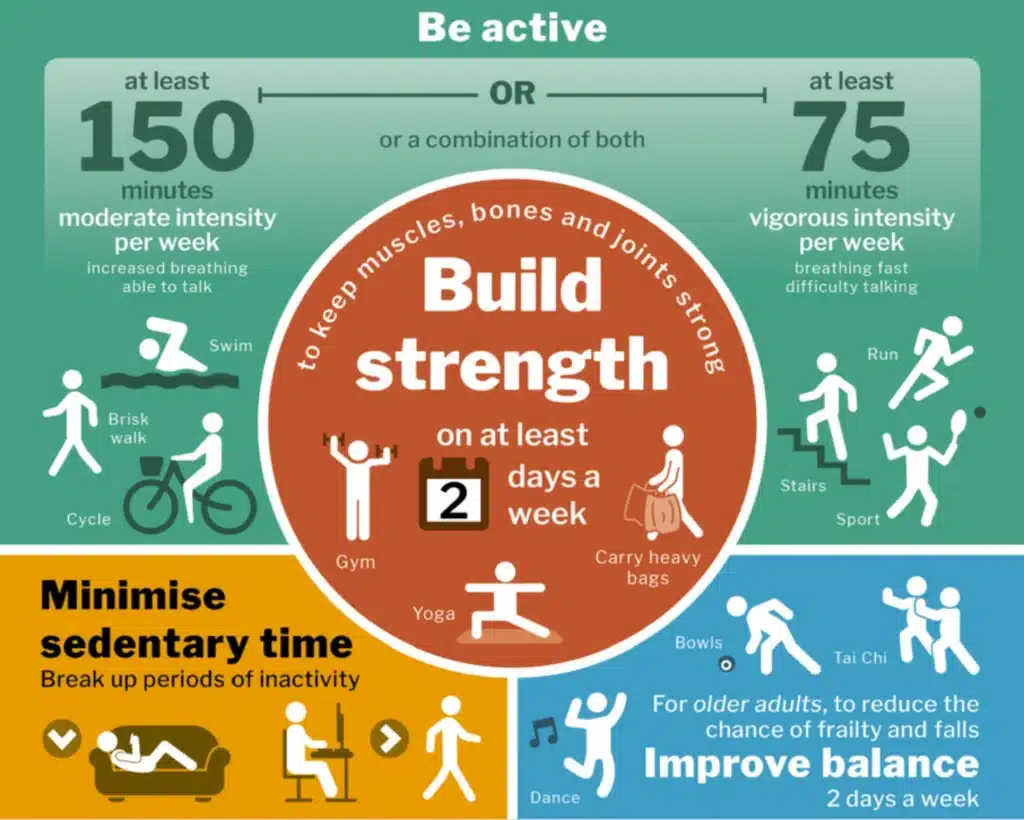
And although a gym session is great, it doesn’t mean we should spend the rest of the day sitting down. Regular movement throughout the day matters too.
So how many steps do we need?
Research has consistently linked higher daily step counts with a lower risk of premature death. A 2022 meta-analysis of 15 international cohorts involving more than 47,000 adults found that the benefits increased as people took more steps, although the point at which these benefits began to level off varied with age.
For adults aged 60 and over, the association appeared to level off at around 6,000–8,000 steps per day, while for adults younger than 60, it was closer to 8,000–10,000 steps.
Importantly, this doesn’t mean you need to reach these numbers to benefit. The research suggests that moving more, particularly if you’re currently taking very few steps, can make a meaningful difference.
More recently, researchers have looked beyond mortality to investigate how daily step counts are associated with a wider range of health outcomes.
A 2025 systematic review and dose-response meta-analysis published in The Lancet Public Health examined 57 studies from 35 cohorts, with 31 studies included in the meta-analysis. The researchers looked at the relationship between daily steps and outcomes including cardiovascular disease, cancer, type 2 diabetes, dementia, mental health, physical function and falls.
The results suggest that around 7,000 steps a day is associated with meaningful health benefits across several outcomes when compared with just 2,000 steps a day.
For some outcomes, such as all-cause mortality, cardiovascular disease, dementia and falls, the benefits appeared to level off around 5,000–7,000 steps a day. For other outcomes, including type 2 diabetes, cancer mortality and depressive symptoms, the relationship appeared more linear, with benefits continuing as step counts increased.
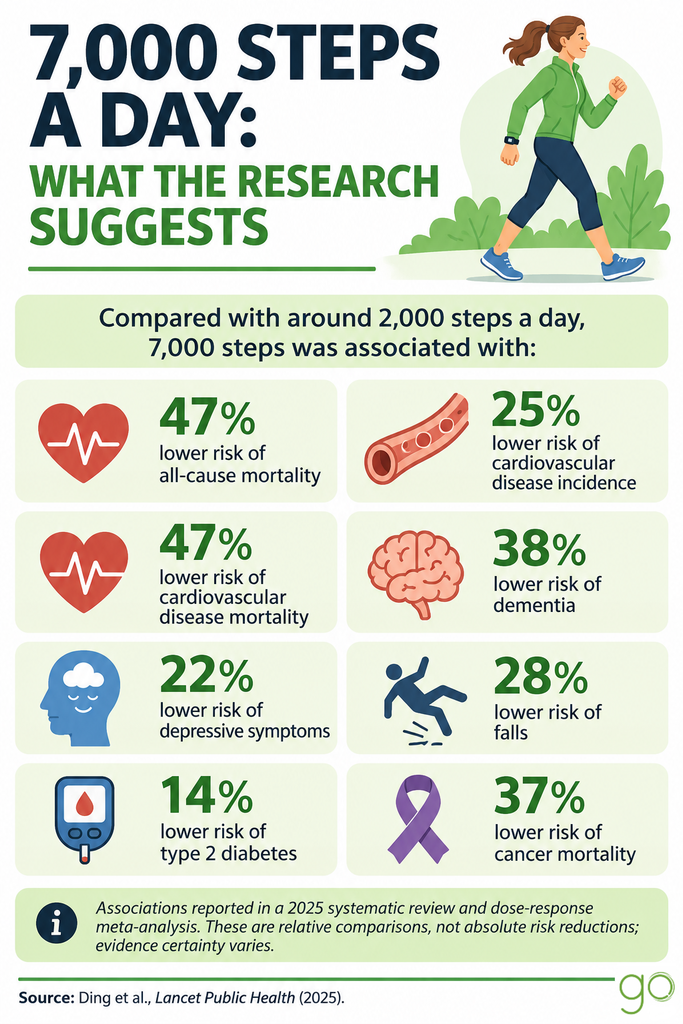
Although these findings are encouraging, the researchers highlighted limitations, including the relatively small number of studies available for many individual outcomes, a lack of age-specific analysis and the potential for bias or other factors to influence the results.
Nevertheless, the findings suggest that 7,000 daily steps could be a realistic and worthwhile target for many people, rather than feeling that 10,000 steps is essential.
So what is this telling us?
For more than 60 years, 10,000 steps has been seen as the gold standard for daily activity. But research suggests we don’t necessarily need to reach that number to enjoy meaningful health benefits.
Around 7,000 daily steps appears to be a worthwhile target for many people, although some health benefits may continue as we increase our steps further.
But it’s important not to get too caught up in the numbers. If you’re currently taking 2,000 steps a day, increasing to 3,000 or 4,000 is a great place to start. You don’t need to go from barely moving to 10,000 overnight.
The key is to build movement into your everyday life, find a target that works for you and keep it consistent. Every step counts!
Tips on increasing your steps
If you’re looking to increase your daily step count, here are a few simple ways to get started.
- Start where you are. If you’re currently taking 2,000 steps a day, don’t suddenly aim for 10,000. Start with a manageable increase and gradually build on it.
- Set a realistic target. Around 7,000 steps is a useful goal for many people, but it doesn’t have to be yours. Choose a target that feels achievable but still gives you something to work towards.
- Break it up. You don’t need to complete all your steps in one go. Short walks throughout the day can add up.
- Make it part of your routine. Walk to the shops, take the stairs, park a little further away or get out for a walk during your lunch break.
- Walk with someone. Catch up with a friend, take the dog out or involve the family. It can make walking more enjoyable and help you stick to the habit.
- Keep track, but don’t obsess. Fitness trackers can be a useful way to monitor your activity and motivate you, but don’t worry if you don’t hit your target every day.
- Invest in comfortable footwear. A comfortable pair of trainers can make walking much more enjoyable, especially if you’re gradually increasing your distance.
The most important thing is to find ways to move more that fit into your everyday life. Consistency matters more than chasing a number.