
So we are all aware that we need to exercise to be healthy and most of us probably know this needs to be regular exercise. But, this is easier said than done! Starting with a new year’s resolution, or trying to get into shape for your summer holiday can provide short term motivation, but keeping that going regularly for our health, can be much more difficult to sustain.
Making exercise part of our everyday routine, forming this new habit, can take a little while to get right, (or even a long while!). The 6 week fad of a new exercise class everyone is talking about, or running club training for an event can start to give us a focus, but when its bad weather, or dark nights, or the new season of your favourite series comes out, your good intentions of regular exercise, may be tested. Now we have acknowledged that motivation and other factors may make regular exercise difficult, what is classed as regular exercise?
The Government’s physical activity guidelines for healthy adults is to do 150 minutes of moderate intensity aerobic activity, or 75 minutes vigorous intensity (or a mixture of both) spread out over the week. Alongside at least two strengthening activities a week and 2 balance sessions (NHS).
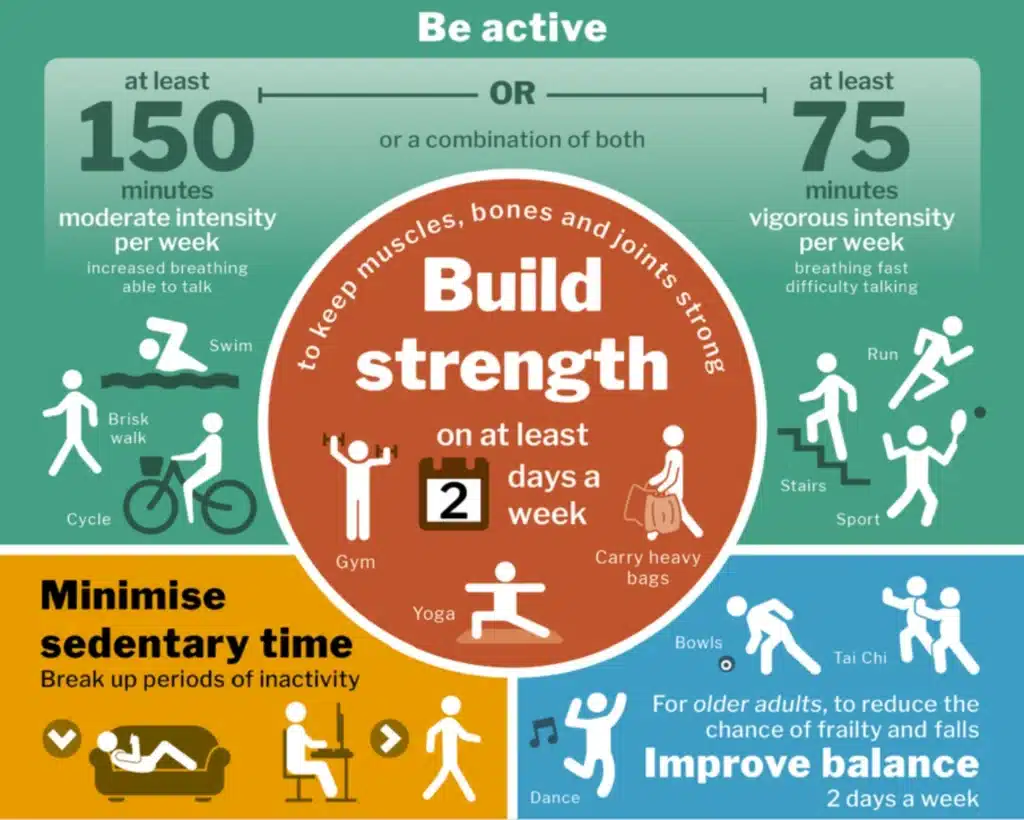
Lastly, there is also a focus on reducing sedentary time, (more on that in another blog).
There are numerous activities available for people to try and fulfil these guidelines. Moderate intensity aerobic activity could be; brisk walking, dancing, gardening, bike riding, water aerobics, rowing etc.
For moderate intensity your heart rate will have gone up a bit, so will your breathing rate and you will feel a bit warmer, but you can still have a conversation. Moderate will be a different level for everyone depending on your fitness level.
Vigorous activities will include; running, team sports like football, hockey or rugby, skipping, martial arts etc. Vigorous intensity makes you breath hard and fast, you can only say a few words without pausing for breath.
We have all heard of the activities listed above and know we need to do aerobic/cardio, however strength training is often overlooked, but is paramount for all population groups. Building/retaining muscle mass has significant health benefits such as; metabolic advantages, improved blood sugar control, reduced risk of chronic disease and a reduced risk in all cause mortality.
There is also good literature to support doing balance activities as part of a regular exercise routine. The benefits of these differ depending on the individual. Balance exercises can strengthen muscles, increase power output for the regular athlete and help reduce the risk of, and damage from a fall in the older population.
What are the benefits of regular exercise?
The evidence for regular physical activity is compelling. In adults there is strong evidence for the protective effects of physical activity on a range of chronic conditions including; heart disease and mental health. Regular physical activity can save the health system an astronomical amount. Also physical activity can have wider social benefits for the community, including increased productivity in the workplace and reduced congestion. However, we will focus on regular physical activity and the effects on health.
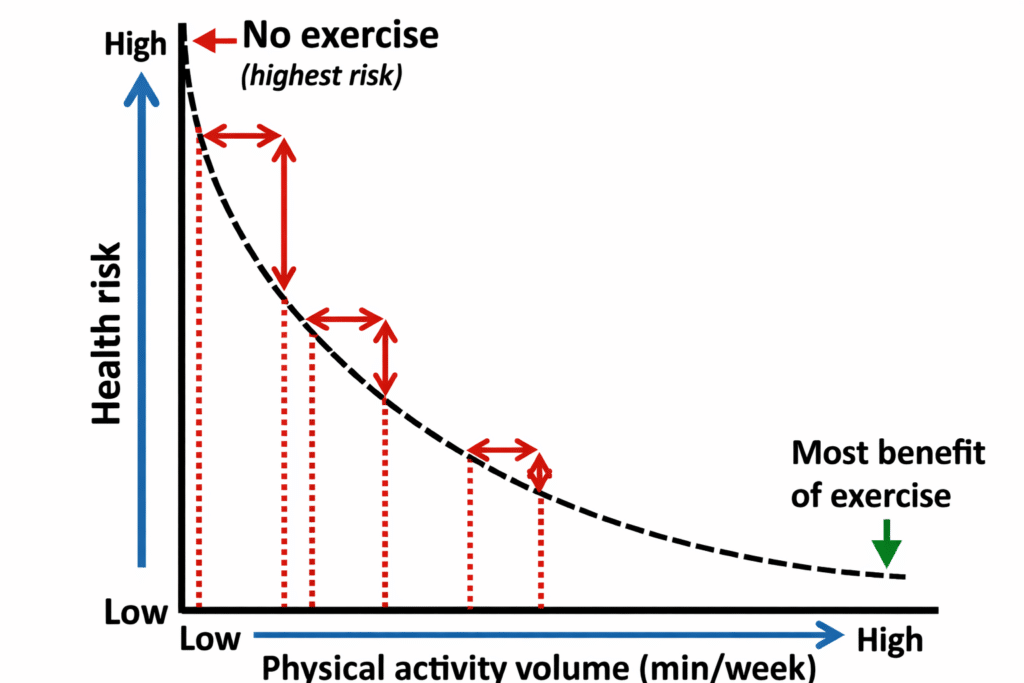
Where to begin with the benefits of regular exercise…There are short term effects to exercise such as; increased heart rate and blood pressure, however we are going to look at the benefits of regular exercise and will therefore be looking at the benefits of long term exercise. We previously highlighted the need for; aerobic, strength, and balance training. We will focus on aerobic and strengthening in this blog and look at the health benefits of these type of training (for more on health benefits of balance training, see our blog).
Aerobic/Cardio health benefits
So first, benefits of aerobic/cardio training..in a nutshell, with regular aerobic exercise you will get stronger and fitter.
Keep your weight healthy
Aerobic exercise can help you lose weight, when combined with a healthy diet. Being a healthy weight makes you move more efficiently, feel better and helps to reduce a risk factor for multiple chronic conditions.
Reducing risk factors
As mentioned above, regular exercise can help reduce the risk factor of many chronic conditions including; obesity, type 2 diabetes, certain cancers and heart disease to name a few, Also regular exercise is good for bone health, reducing osteoporosis risk from weight bearing exercise.
Manage existing health conditions
If you do have any chronic conditions, aerobic exercise can help you manage these and may form part of your treatment plan with your doctor. Exercise can be used for depression as exercise improves your sense of well-being and releases endorphins. Or for people with arthritis, aerobic exercise can help them maintain function and independence. It may also reduce the pain they experience (Mayo Clinic 2023).
Heart health
I think we all associate cardio training with heart health. The heart is a muscle and so when it is worked, it gets stronger. A stronger heart pumps blood more efficiently and can beat slower.
Heart health can be a risk factor for any age, but especially for men post 40. Also in terms of heart health, regular exercise can help keep your cholesterol in check, increasing HDL (good cholesterol) and decreasing LDL (bad cholesterol). These results may decrease atherosclerosis (build up of fatty plaque) in the arteries that can lead to heart attack.
Improve fitness
Things will become easier! Whether it is everyday tasks, or your workouts. Heart and lung function improves, making tasks easier and resulting in less fatigue.
There are many more benefits from regular aerobic exercise; improved sleep, a boost in mood, increase energy etc, but we will be here a while so moving onto the benefits of regular strengthening exercises.
Benefits of regular strength training
The benefits of regular strength training in terms of health benefits is a newer theory than aerobic training. As it is a newer theory, often it is misunderstood. For clarity; strength exercises are any exercise, using your bodyweight or equipment to build muscle mass, muscular endurance or strength. The literature is unequivocal in support of strength training having a positive effect on improving people’s health.
Makes you strong
When you are stronger, you can do your daily jobs much easier from the housework to moving furniture. Also, for the more athletic, it can improve multiple other fitness components such as power and speed.
Keeping weight in check
– Regular strength training increases metabolic rate post training up to 48 hours (Aristizabal et al 2015). This increases calories burned and helps with a healthy weight. Lean muscle mass is also increased so the body is more lean and toned. The more muscle percentage you have, the higher your metabolic rate and higher your resting metabolic rate so you burn more calories at rest.
Decrease fat percentage
Strength training decreases body fat, especially visceral fat around the mid section that is associated with an increase in chronic conditions. So in terms of health and also an aesthetics point of view, this is a must.
Less injuries
As long as you are doing appropriate exercises correctly, less injuries. The muscles around the joints are strengthened and so are the ligaments and tendons which support the joints in everyday movements and also during exercise. Having stronger joints can help protect and slow further damage to our joints such as from arthritis.
Improved heart health
Heart health is improved with strength training, similarly to aerobic training, however many of the studies are much more recent. Regular strength training can decrease blood pressure and lower cholesterol by strengthening the circulatory system, including the heart.
Manage blood sugar
There are many areas where strength training can improve your blood sugar. The fitter you are the lower your risk of developing type 2 diabetes. As muscle percentage increases, so does insulin sensitivity. Also, glucose (circulatory sugar), is taken from the blood to the muscle cells. These factors all contribute to better management of blood sugar and with almost 6 million people living with a diabetes in the UK, this is a massive issue for us all (Diabetes UK).
Makes you feel good
Studies show strength training is great for self confidence and self efficacy (Collins et al 2019). These 2 go hand in hand and are often transferable to other areas of a person’s life. Also, the negative emotions we feel such as anxiety can be reduced with regular strength training (Strickland and Smith 2014). This is thought to be from a number of mechanisms including lowering your cortisol levels and the increase of endorphins.
Brain health
Improvements in cognitive function and improvements in memory are largely accepted as a result of regular strength training. The reasoning behind this is reduced inflammation, improved blood flow and increased BDNF to promote memory and learning (Sanaeifar 2024).
What happens when we don’t exercise regularly?
It’s pretty simple, all the benefits we just talked about, don’t happen. We will also be at higher risk of developing risk factors and/or chronic conditions. We have an increased risk of type 2 diabetes, CVD, some cancers, premature mortality, reduced cognitive function and obesity, just to name a few!
This is supported by numerous studies over many decades that promote the benefits of regular exercise and also the risk of non exercise/sedentary behaviour. A quick search on Google and you will find hours of reading, (just be cautious of Googling as we know how that can go)!!!
So how can we fit regular exercise into our busy lives?
So we know what we need to do and why but how can we fit this into our already full schedule?
Start small – don’t dive in all guns blazing, start gradually and build up. Especially if you are new to exercise or haven’t exercised in a while, speak to your GP first.
Set goals – Some people love them, some hate them, but you can’t be accountable and track progress without setting some goals. Remember make them SMART.
Plan it out – Whether you’re a planner or not, all of us are busy and fitting something new in our lives needs a bit of planning. For example; planning out your food, prepping lunch or buying the right ingredients so you don’t end up with a Greggs sausage roll and a coffee for lunch!
Even having your activity program on the fridge and getting your workout clothes ready the day before can make all the difference to getting the job done.
Give it respect and time – anything important in our lives needs respect and time. Respect it with time in your routine and as time passes, you can measure your exercise consistency and see the benefits you are getting with regular exercise.
Exercise snacking – a more modern method (see other blog) includes adding small amounts of exercise throughout your day. This is great for breaking upsedentary time and fitting in with your current busy schedule. Making it more achievable makes it more likely to form a habit.
Getting Friends or family involved – This is one of my favourites because it has multiple benefits. Depending on what your motivations are and what your barriers are, these can be adapted to make your exercise a habit. A workout or walk with a friend, a gym session or meal prepared with a family member is great for all. The physical, psychological and social benefits are endless.
Lasly, to make exercise a regular habit, make sure you cover all areas; cardio, strength, balance and reducing sedentary time. Not only does this keep it fresh and motivating, it covers all the health criteria we need.
References
Aristizabal, J, C. Freidenreich, D, J. Volk, B, M. Kupchak, B, R. Saenz, C. Maresh, C, M. Kraemer, W, J. Volek, J, S. (2015). Effects of resistance training on resting metabolic rate and its estimation by a dual-energy X ray absorptiometry metabolic map. European Journal Of Clinical Nutrition. Vol 69, pp831-836.
Collins, H. Booth, J, N. Duncan, A. Fawkner, S. Niven, A. (2019). The Effect of Resistance Training Interventions on ‘The Self’ in Youth: a Systemic Review and Meta-analysis. Sports Med Open. Vol 3, issue 5, pp29.
Diabetes UK. (2024). How many people in the UK have diabetes?
Franklin, B. Thompson, P. Al-Zaiti, S. Albert, C. Hivert, M. Levine, B. Lobelo, F. Madan, K. Sharrief, A. Eijsvogels, T. (2022). Exercise-Related Acute Cardiovascular Events and Potential Deleterious Adaptations Following Long-Term Exercise Training: Placing the Risks Into Perspective–An Update
Mayo Clinic – flexibility training advantages for older populations.
Mayo Clinic. (2023). Aerobic exercise; Top 10 reasons to get physical. Healthy Lifestyle Fitness.
NHS – government recommendations for healthy adults for physical activity.
Sanaeifar, F. Pourranjbar, S/ Pourranjbar, M. Ramezani, S. Mehr, S, R. Wadan, A, S. Khazeifard, F. (2024). Beneficial effects of physical exercise on cognitive-behavioural impairments and brain-derived neurotrophic factor alteration in the limbic system induced by neurodegeneration. Experimental Gerontology. P195.
Strickland, J, C. Smith, M, A. (2014). The anxiolytic effects of resistance exercise. Front psychology. Vol 10, issue 5, pp 753.