The UK has an ageing population which has been the trend for many years due to advances in medicines and treatment. This does not show signs of changing with the only deviation being the consequence of covid-19. As we enter 2026 the average life expectancy in the UK is 81 years old, with women having a few more years on their male counterparts (79.1 years for males and 83.0 years for females) (ONS 2025). It is not uncommon for a family to have a nonagenarian.
Not only is life expectancy important, but as discussed many times; health span is SIGNIFICANT. We want to live our best lives, independently, in good health, contributing to our community.
When discussing physical activity for seniors the government have set recommendations for older people. The government classifies older people as people over 65 years of age.
Physically active everyday, even if it’s just light intensity
- Do activities to improve strength, balance and flexibility on at least 2 days of the week
- At least 150 minutes of moderate intensity aerobic activity, or 75 minutes vigorous activity (if suitable), or a mixture of both (if suitable)
- Reduce sitting time
As with all guidelines, these are general and therefore not suitable for everyone. Some seniors may be habitual exercises. Others may have never exercised for many many years. Others may have health conditions and these guidelines will not be suitable, that’s why it is necessary to check with your GP before commencing a program.
The activities as you can see fall into different categories, aerobic (cardio), strength, balance and flexibility.
Intensity was also mentioned, it is often divided into 3 categories; light, moderate and vigorous. Lets demystify these a bit……….
Light intensity – moving around easy, you can still sing
Moderate intensity – Raises heart rate and breathing a bit, you feel warmer, you can still have a conversation (but not sing)
Vigorous intensity – Breath hard and fast. Only say a word or 2 without pausing for breath (not suitable for many).
(Depending on your fitness level, health outcomes and what the GP says, the intensities you work at will be specific for you).
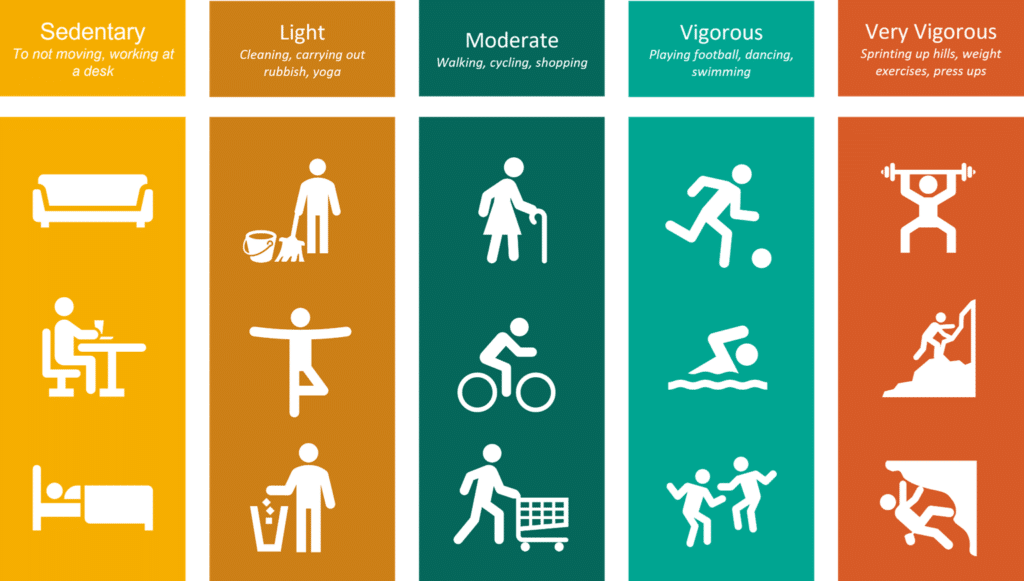
There are so many activities that fall into these different categories and they will be determined by what you enjoy, access to facilities, time and any limitations you have. So now we know what we need to do, what activities count to allow us to hit our targets?
Activity options
Activities options are endless and can be adapted depending on interests, intensity and your fitness level. For example a walk can be a stroll – light intensity, a brisk walk – moderate intensity, or a run – vigorous intensity. Whereas a walk for another person maybe a leisurely saunter – light intensity, a steady walk – moderate intensity and a brisk walk – high intensity. It all depends on the fitness level of the person.
Aerobic (or cardio)
Can cover an array of activities. Examples of what you can do;
- Walking
- Table tennis
- Jogging/running
- Dancing
- Tennis
- Cricket
- Hiking
- Housework
- Badminton
- Gardening
- Pickleball
- Swimming
- Martial Arts
Strength activities
To build/maintain muscle. You can use;
- Tai chi
- Gardening
- Lifting weights – machine or free weights resistance bands
- Yoga
- Body weight exercises
- Carrying shopping
- Pilates
Balance and flexibility exercises
Some of the activities above tick these boxes; tai chi, yoga or even specific balance sessions. But remember do what you enjoy and is in your capabilities. Any exercises can be adapted, for example if you need seated exercise. Doing a little is better than doing nothing and doing more is better than a little, however you need to build up gradually and listen to your body.
You may have noticed day-to-day jobs count towards your activity and rightly so! It doesn’t have to be a structured hour gym session, even though for some it may be. It could be a walk from town with your shopping, cutting the lawn or a spring clean. This all counts towards your activity and as we saw earlier, ticks the boxes for aerobic (cardio) and strengthening exercises while also reducing your sedentary time (time spent sitting).
So what are the benefits for seniors doing this activity?
I think we can all agree, when we are active, eating well, being social then we usually feel better within ourselves and about ourselves. The benefits are vast in terms of physical health and psychological health.
Being active benefits us physically by; improving cardiovascular health and maintaining muscle mass and strength Being active also reducing risk factors such as; hypertension, high cholesterol and high blood sugar. While also reducing the risk of chronic conditions such as; heart disease, type 2 diabetes, obesity and some cancers.
Being active also helps protect our bones against osteoporosis, which as we age increases our chance of fracture. This is a very significant benefit for any senior, especially females due to hormonal changes.
Strength training maintains/increases muscle mass which is very important as we age (see blog on muscle mass and ageing), as a reduction in muscle mass is linked to increased mortality rate and increased chance of falls (Srikanthan 2014). Falls can lead to many complications that can occur as a result or broken bones and surgeries, not to mention the psychological stress from rehabilitation. Keeping bones and muscles strong will help people maintain living independent lives and contributing to their family and community.
The psychological benefits of activity are also well documented. The release of endorphins during activity makes you have the feel good factor. Staying active in the community and living life independently to the fullest has a profound impact on your psychological health. The social benefits of activity such as the comradery at a walking group or a tai chi class can be a pivotal factor for many people (Hanson and Jones 2015).
The other benefits of doing activities with a peer include connecting with a friend, meeting new people who are like-minded and share similar interests. If the activity is done outside, like a cycle or hike, you also benefit from reduced depression, exposure to vitamin D, improved awareness and mental well being. Other psychological benefits include an increase in self efficacy and self confidence (Han et al 2022). As people reach retiring age, finding a new routine and place in society can be challenging for some. Activity can provide routine and friendship for people in this new stage of their life.
Working on flexibility and balance has the obvious benefits of keeping you moving and doing what you enjoy safely while making you feel better and more confident in you lives. In terms of psychological benefits working on these two components can be the difference between enjoying the activities they have always enjoyed, or avoiding situations through fear that may lead to people becoming isolated and increasing their risk of falls.
Standing out to me are the benefits of activity (physiologically and psychologically) that allow a person to remain strong, active and mobile for as long as they can. Remaining independent, just because you are ageing in years. Activity can become such an integral part of a person’s journey, offering not just physical and psychological benefits, but having a real impact on a person’s life by giving them the qualities they need to be independent and strong.
In Summary, do what activity you can do and what you enjoy. Check first with a GP and work with a PT if you can. The more activity you can do the better, but some is better than none and build up gradually listening to your body.
The government gives guidelines for older adults (over 65 years), but it depends on what health conditions you have and your fitness level. Intensity may be; low, moderate or high and will include; aerobic (cardio), strengthening, balance and flexibility. Also remember reducing sedentary time is important. The benefits are huge – physiological and psychological. However, I think the most important factor is living independently, as a strong member of the community.
So find what you enjoy and do that 😊
You should speak with your GP before you start any exercise program and also work with a qualified professional such as a Personal Trainer if you can.
References
Han, S. Li, B. Wang, G. Ke, Y. Meng, S. Li, Y. Cui, Z. Tong, W. (2022). Physical Fitness, Exercise Behaviors, and Sense of Self-Efficacy Among College Students; A Descriptive Correctional Study. Movement Science. Vol 13.
Hanson, S. Jones, A. (2015). Is there evidence that walking groups have health benefits? A systemic review and meta-analysis. British Journal of Sports Medicine. Vol 49, Issue 11.
ONS. (2024) Office for National Statistics. Census 2021. National lifetables – life expectancy in the UK; 2020 to 2022.
Srikanthan, P. Karlamangla, A, S. (2014). Muscle Mass Index as a predicator of longevity in older adults. Clinical Research Study. Vol 27, issue 6, pp547-553.